The Toolkit / Research / The Compass
Research · Tool 01 of 16
The Compass
Find the signal in the noise.
See which trends are rising or falling in the spaces you care about, who is driving them, and which way to go.
The board
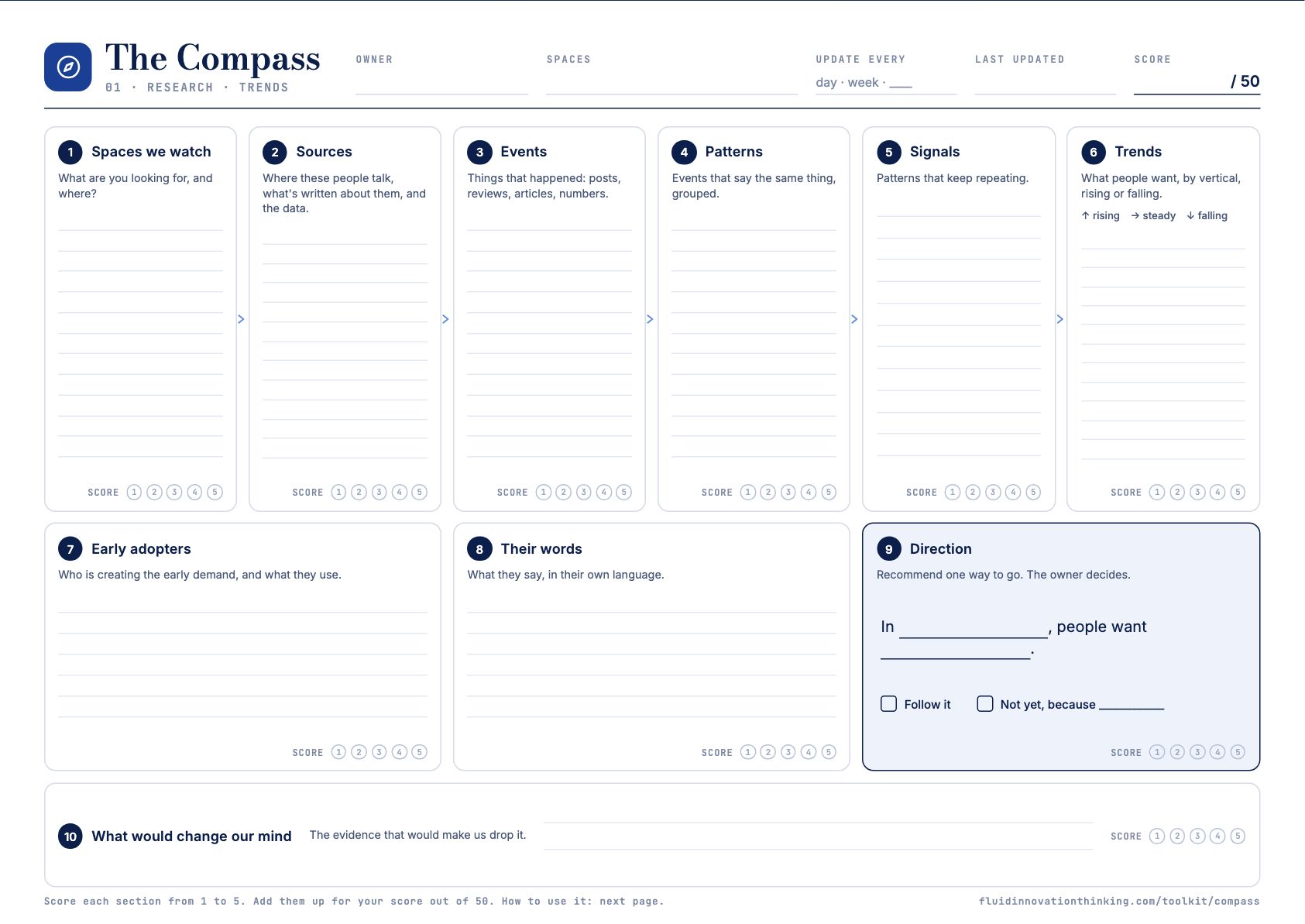
Ten sections on one page
Print it, fill it in, and score each section from 1 to 5. Your score is out of 50.
How to use it
The ten sections of the Compass
What to do in each section, and what a 1, a 3 and a 5 look like. Score yourself honestly; the low scores tell you where to work next.
- 1
Spaces we watch
What are you looking for, and where?
Name the spaces to watch (verticals, kinds of people, kinds of problems) and what you're looking for in each.
- 1Started
- One vague space (“AI”).
- 3Good
- Two or three named spaces, each with what you're looking for.
- 5Excellent
- Clear spaces, each with what's in and out of scope, reviewed this month.
- 2
Sources
Where these people talk, what's written about them, and the data.
List where these people talk online, and the news and data that cover them.
- 1Started
- A couple of websites you already knew.
- 3Good
- Places they talk, plus news and data, each with a link.
- 5Excellent
- The full map: communities, newsletters, feeds and data, each rated for usefulness, new ones added this month.
- 3
Events
Things that happened: posts, reviews, articles, numbers.
Capture what happened: a post, a review, an article, a number. Keep the link and the date.
- 1Started
- A handful, without links.
- 3Good
- Events from several sources, each linked and dated.
- 5Excellent
- A steady flow at your rhythm, from every kind of source, each linked, dated and tagged to a space.
- 4
Patterns
Events that say the same thing, grouped.
Group events that say the same thing, and name each group.
- 1Started
- Events loosely sorted.
- 3Good
- Named patterns, each with three or more events.
- 5Excellent
- Every event sits in a pattern or is marked as noise; patterns draw on more than one source.
- 5
Signals
Patterns that keep repeating.
Mark the patterns that keep repeating over time.
- 1Started
- A pattern seen once, called a signal.
- 3Good
- Signals that repeated across several updates.
- 5Excellent
- Each signal shows how often it repeats and in how many independent sources, and is still repeating.
- 6
Trends
What people want, by vertical, rising or falling.
Name each repeating signal as a trend: what people want, in one vertical. Mark excitement and sentiment as rising, steady or falling.
- 1Started
- Buzzwords (“AI is big”).
- 3Good
- Trends written as what people want, each with a heading.
- 5Excellent
- Each trend in the people's own terms, with its heading over time and the signals behind it.
- 7
Early adopters
Who is creating the early demand, and what they use.
Name the people and groups creating the early demand, and the tools they're adopting.
- 1Started
- “Early adopters” in general.
- 3Good
- Named groups or public voices for each trend.
- 5Excellent
- For each trend: named public voices and communities, what they use and where they talk. Ready for the Storyboard.
- 8
Their words
What they say, in their own language.
Save what they say, word for word, with the source.
- 1Started
- Paraphrases.
- 3Good
- Several quotes per trend, each with its source.
- 5Excellent
- Quotes for every trend, sourced and dated, showing the pain and the want in their own language.
- 9
Direction
Recommend one way to go. The owner decides.
Recommend one direction: in this vertical, people want this. The owner says follow it, or not yet.
- 1Started
- A vague direction, or everything at once.
- 3Good
- One direction, with the trend behind it.
- 5Excellent
- One direction backed by a rising trend, its early adopters and their words, with the owner's decision and the date.
- 10
What would change our mind
The evidence that would make us drop it.
For the direction and each top trend, write the evidence that would make you drop it.
- 1Started
- A vague worry, nothing you could check.
- 3Good
- One line for the direction.
- 5Excellent
- Specific, checkable lines for the direction and every top trend (“if talk falls three months running…”), checked at every update.
How it works
- Made inStep 01 · TrendsFind the signal in the noise: what people in your spaces increasingly want, rising or falling.
- What it's forSee which trends are rising or falling in the spaces you care about, who is driving them, and which way to go.
- It feedsThe StoryboardFind the humans behind the trend.