The Toolkit / Development / The Sketchbook
Development · Tool 05 of 16
The Sketchbook
Draw it before you build it.
Figure out what you're going to build before you build it: the whole thing, cut into small chunks that can each change on their own.
The board
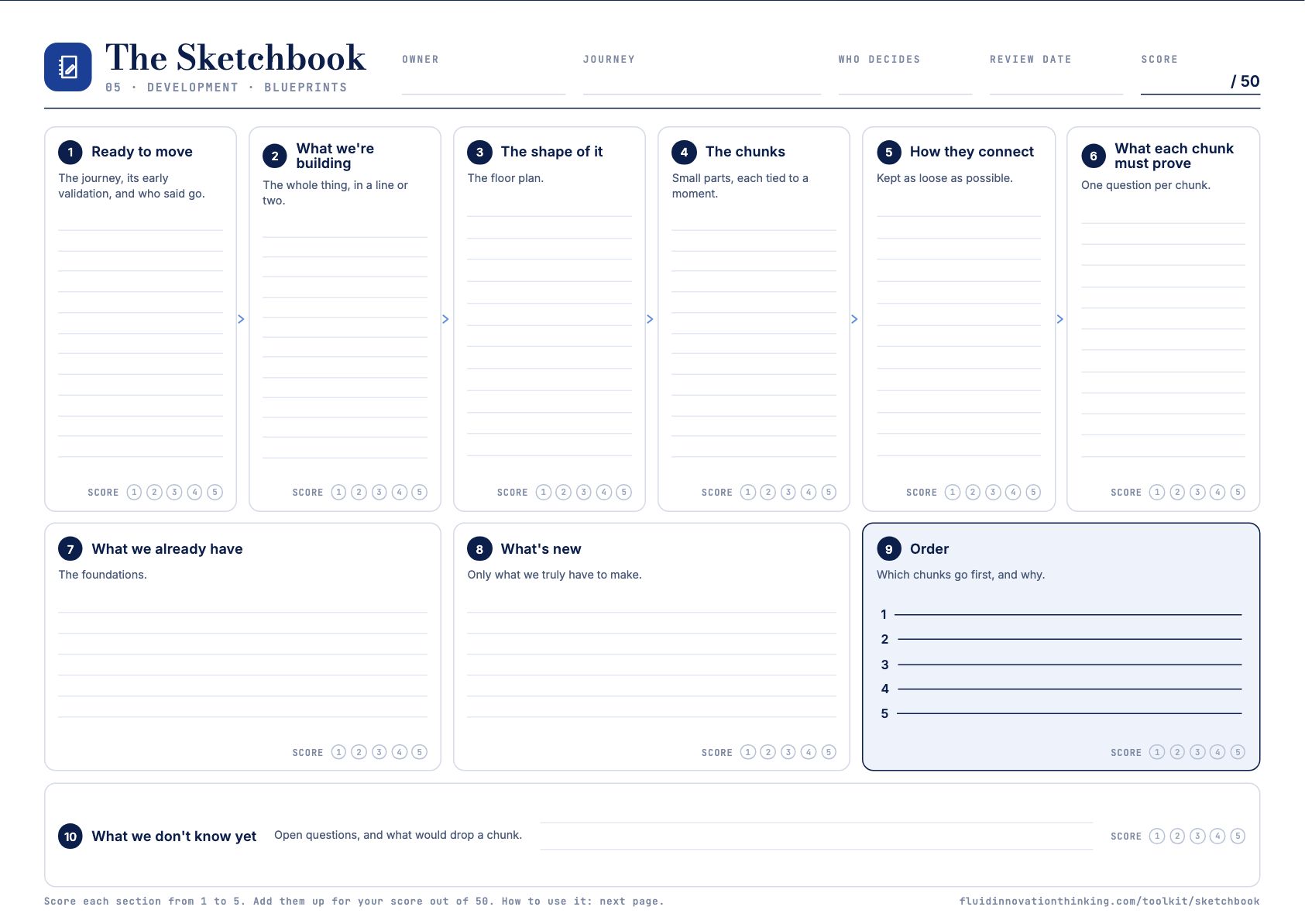
Ten sections on one page
Print it, fill it in, and score each section from 1 to 5. Your score is out of 50.
How to use it
The ten sections of the Sketchbook
What to do in each section, and what a 1, a 3 and a 5 look like. Score yourself honestly; the low scores tell you where to work next.
- 1
Ready to move
The journey, its early validation, and who said go.
Name the journey that passed the Simulator, what showed it's ready, and who said “go”.
- 1Started
- A journey nobody has tested.
- 3Good
- A journey with some thumbs up from the Simulator.
- 5Excellent
- A journey with thumbs up from both the panel and real people, and the owner's “go” with the date.
- 2
What we're building
The whole thing, in a line or two.
Say what you're building and who it's for, in one or two plain lines.
- 1Started
- A feature list.
- 3Good
- A clear line on what it is.
- 5Excellent
- One or two lines anyone could repeat: what it is, who it's for, and the moment it serves.
- 3
The shape of it
The floor plan.
Sketch the whole thing and its main parts, like a floor plan.
- 1Started
- A list, not a shape.
- 3Good
- A simple sketch of the main parts.
- 5Excellent
- A clear sketch where every part traces back to a moment in the journey.
- 4
The chunks
Small parts, each tied to a moment.
Cut it into chunks: each one something a person can touch, small enough to build in days.
- 1Started
- Big parts that take months.
- 3Good
- Several small chunks, each tied to a moment.
- 5Excellent
- Small chunks that each stand alone, can be built in days and dropped without breaking the rest.
- 5
How they connect
Kept as loose as possible.
Write what each chunk needs from the others, and keep it as little as possible.
- 1Started
- Everything depends on everything.
- 3Good
- The main links between chunks written down.
- 5Excellent
- Only the links that must exist, so each chunk can change, ship or be dropped on its own.
- 6
What each chunk must prove
One question per chunk.
Give every chunk one question it must answer once built.
- 1Started
- No questions, just tasks.
- 3Good
- A question for most chunks.
- 5Excellent
- A clear, checkable question for every chunk, written before anything is built.
- 7
What we already have
The foundations.
List the people, data, customers and tools you can build on.
- 1Started
- Starting from nothing.
- 3Good
- The main things you can reuse.
- 5Excellent
- Everything you can rearrange first, matched to the chunks that will use it.
- 8
What's new
Only what we truly have to make.
List only what you must build new.
- 1Started
- Everything is new.
- 3Good
- A short list of new things.
- 5Excellent
- A minimal list, each new thing justified by a chunk nothing else can serve.
- 9
Order
Which chunks go first, and why.
Number the chunks in the order you'll build them, starting with what's riskiest or most valuable.
- 1Started
- A rough guess at an order.
- 3Good
- An order.
- 5Excellent
- An order that builds the riskiest, most valuable chunk first, with a line on why.
- 10
What we don't know yet
Open questions, and what would drop a chunk.
List what's still open, and the result that would make you drop each chunk.
- 1Started
- A vague worry.
- 3Good
- The main open questions.
- 5Excellent
- Every open question, each with the result that would drop the chunk it belongs to.
How it works
- Made inStep 05 · BlueprintsFigure out what you're going to build before you build it, in small chunks.
- What it's forFigure out what you're going to build before you build it: the whole thing, cut into small chunks that can each change on their own.
- It feedsThe CanvasDesign the moment, not the screen.